
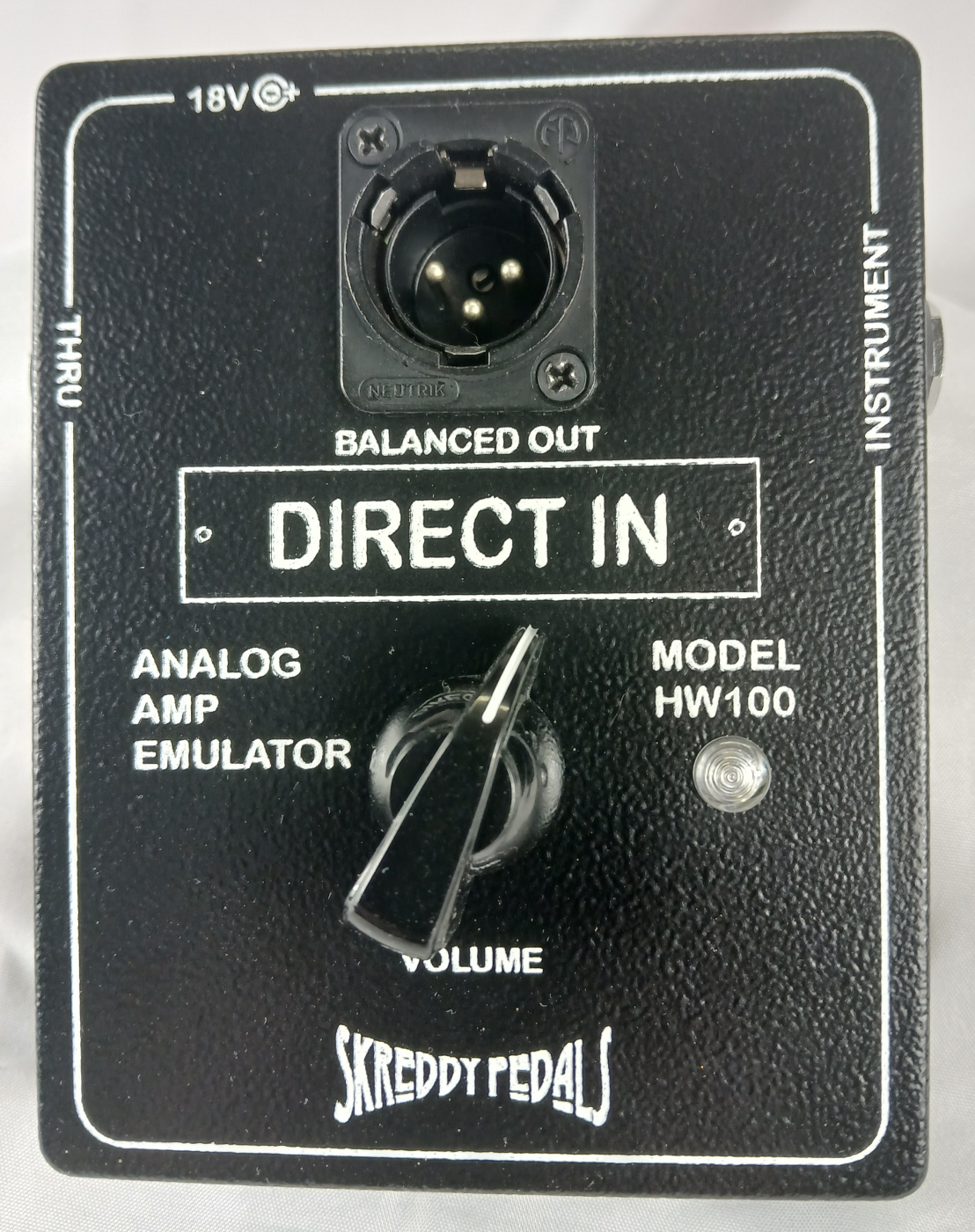


Direct In
Analog amp emulator for electric guitar that takes to fuzz pedals like a duck to water
Direct box for electric guitar that emulates a mic'd clean, pedal-friendly amp's sound, so you can gig or record without an amp while enjoying the real amp's organic sound
- Transparent low end
- Mids are chimey, not muddy or honky
- Treble is bright but never harsh even when feeding it extreme fuzz or distortion
Perfect for "silent stage" venues or any time you don't want to lug your amp along.
Even if you don't plan on going amp-less, you can keep it on your pedalboard as an insurance policy in case your amp ever breaks down at a gig.



Plug your pedalboard's output into its input, connect it to the mixer board or recording interface using an XLR/microphone cable, and use the THRU jack to connect to your amp if you are using one.
Plug and play! All analog; no menus, no complicated setup; just the exact right sound every time. You can always adjust the eq on the sound board or recording interface to dial it in to the context of the mix, but it is ready to go and sounds amazing into a flat eq right out of the box.
The Skreddy Direct In features:
- (a solid-state emulation of) the full preamp section including bridged Normal and Brilliant channels
- 3-band Hiwatt* model tone stack set to my favorite levels (typical David Gilmour settings)
- power amp emulator including Presence calibration
- speaker cab emulator, designed to sound more like Fanes than Celestions; i.e.; more polished top end, clearer and less compressed, with a snappy bass response
- balanced XLR output that sends a strong noise-free signal to the sound board or recording interface (includes a bit of resistance drag to eliminate that typical loud "pop" when plugged in).
THRU JACK
The THRU jack is a passive, parallel line from the INSTRUMENT jack that you can send to your amp on stage or any other 1/4" instrument split you might want. The input impedance of the active circuit is very high, so it won't suck much tone when you split its signal passively. Any passive split will suck some tone, though; and this depends on the input impedance of the other (parallel) circuit. I chose to keep it passive rather than risk altering the tone being passed through with an extra buffer circuit; plus this way it will always work even if the Direct In is not powered up. Another benefit of keeping the THRU jack passive is that you can actually use either the INSTRUMENT or the THRU jack as your input, depending on the way you prefer to set up your board and cables.
VOLUME
The only adjustable control is VOLUME, which of course you'll want to set to avoid overloading the receiving device. Test for levels using the loudest and most extreme signal peaks you anticipate from your guitar and pedalboard to keep it safely out of the red. If you hear a high-frequency distortion on hard string attacks, this is probably a fast transient that might potentially not register on the dB meter; and the way to fix that is to figure out if the distortion is coming from the Direct In or downstream of it. Turn down the Direct In's VOLUME or the input level of the receiving device slightly to give the receiving device more headroom. Typically you'll find that about 3:00 o'clock is the best starting place. If that doesn't fix it, then the distortion is being produced by too hot an input signal into the Direct In. (see "CLEAN' below)
We've found that the best results into a digital interface are achieved by turning the input gain of the digital interface as low as you can while still getting a usable signal and the Direct In's volume as high as it can go without producing distortion (this is because a typical digital interface will not have a particularly nice-sounding "gain" stage at its input). One of my users actually went with a nice mic preamp between his Direct In and his digital interface, which makes sense if you consider that the Direct In is intended as a one-for-one substitute for an SM57-style microphone positioned in front of a speaker cab.
An analog mixer board (which, by the way, was in fact my initial use case for this device) will be more tolerant of a hot signal than a digital interface. Experiment with the interaction between the VOLUME control and the input gain of the receiving device if you have time.
CLEAN
This is not the sort of amp emulator you should expect to give you any amount of overdrive (that will all come from your pedals); it is bright and clean and articulate yet lush and smooth at the same time. It is designed to give you the most transparent pedal-friendly platform possible, and it does sound like a circa 1977 Hiwatt* model DR103, because I tested meticulously against it until I matched not only the tone of the amp but also of the speaker cabinet frequency response. It features a punchy attack, which approaches the actual feel of the real thing and works exceptionally well at loud gigging volumes, where the particular frequency scoops come into play to prevent excessive ear fatigue or harshness even with raw-sounding fuzz pedals.
The Direct In's preamp stages are made with transistors, though; not tubes. As such, they can not be expected to produce a tube-like distortion when slammed by a hot input signal. So the input into the Direct In needs to be kept at roughly the "unity gain" volume, aka, the strength of just the instrument's output alone, not dramatically boosted. The distortion caused by a too-hot signal will be evident, and you can easily control it by manipulating the volume of the last gain stage feeding it.
FINISH
Finished in a textured black powdercoat that resembles the "elephant skin" tolex of the Hiwatt* amp it's modelled after.
Power supply requirements:
Recommended: 18v for best results. It works fine with 9v, but 18v gives more headroom.
Skreddy pedals use the industry standard Boss/Roland style power supplies, which have
a 5.5mm barrel (positive) and 2.1mm center (negative) coax plug, negative-ground.
Does not have a battery clip; adapter only.
It will not make use of phantom power but is not prone to damage from it either.
* The term "Hiwatt" is used for comparison and does not imply either equivalence to or endorsement of the
fine people at Hiwatt, who of course own their trademarks.
Special thanks to Rod Elliot at

Elliot Sound Products
for all the helpful information, tips, and math you've provided over the years!
Reviews
Tape Op Magazine: Skreddy Pedals: Direct In analog amp emulator DI
Direct In emulates a late-1970s Hiwatt model DR 103 with bridged Normal and Brilliant channels, a power amp with Presence calibration, and a speaker cab designed to sound like a Fane. It delivers a balanced signal via XLR directly into your interface (no line isolator or DI box necessary). The 1/4-inch Thru jack doubles as a second input if that orientation suits your setup better (it sounded the same in my test)...


